
Maintain vs Heat-Up in Electric Heat Tracing Systems
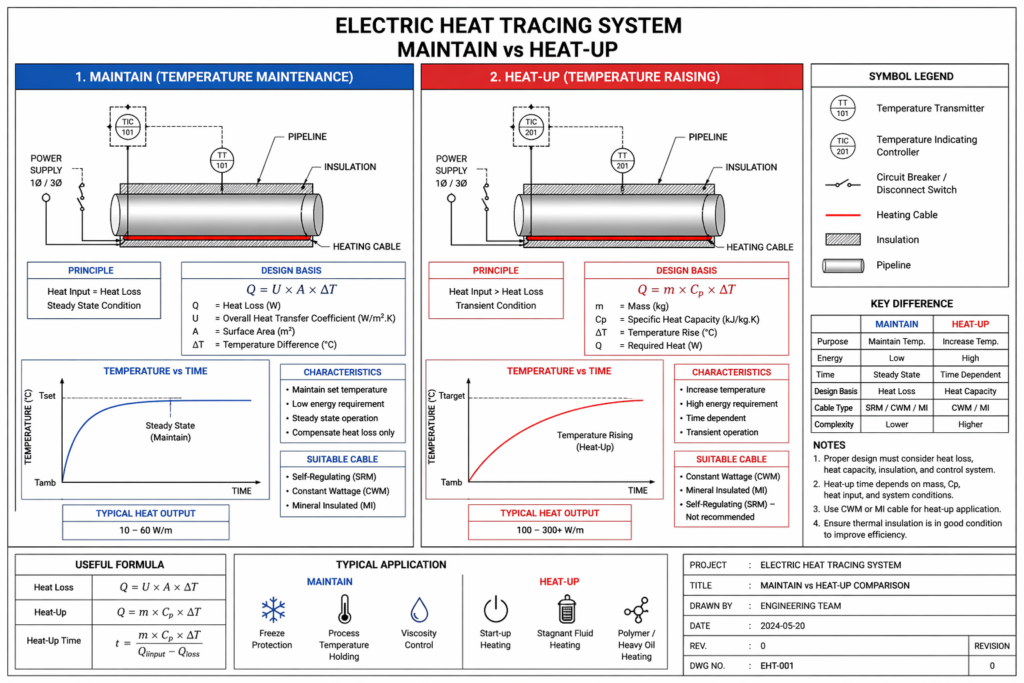
Figure: Comparison of Temperature Maintenance and Heat-Up in Electric Heat Tracing Systems.
The diagram illustrates control philosophy, heat flow, and design basis for both modes.
1. Introduction
Electric Heat Tracing (EHT) is a system used to apply heat to pipes or equipment in order to control the temperature of process fluids such as:
- Polymer
- Oil
- Chemicals
- Water
There are two fundamental design philosophies in EHT that must be clearly distinguished:
1. Temperature Maintenance (Maintain)
2. Temperature Raising (Heat-Up)
Misunderstanding these concepts can lead to incorrect design and system failure.
2. Temperature Maintenance (Maintain)
🔹 Definition
Temperature maintenance refers to maintaining a constant process temperature by compensating for heat losses to the environment.
🔹 Principle
Heat Input = Heat Loss
🔹 Governing Equation
Q = U × A × ΔT
Where:
- Q = Heat loss (W)
- U = Overall heat transfer coefficient (W/m²·K)
- A = Surface area (m²)
- ΔT = Temperature difference (°C)
🔹 Characteristics
- Low energy consumption
- Stable temperature control
- Operates under steady-state conditions
- Does not increase the temperature of the fluid
🔹 Typical Applications
- Freeze protection
- Process temperature holding
- Viscosity control
🔹 Suitable Heating Cables
| Cable Type | Suitability |
|---|---|
| Self-Regulating (SRM) | ✔ Excellent |
| Constant Wattage (CWM) | ✔ Suitable |
| Mineral Insulated (MI) | ✔ Suitable |
🔹 Typical Heat Output
10 – 60 W/m
3. Heat-Up (Temperature Raising)
🔹 Definition
Heat-up refers to increasing the temperature of a fluid or system from an initial temperature to a higher target temperature.
🔹 Principle
Heat Input > Heat Loss
🔹 Governing Equation
Q = m × Cp × ΔT
Where:
- m = Mass (kg)
- Cp = Specific heat capacity (kJ/kg·K)
- ΔT = Temperature rise (°C)
🔹 Characteristics
- Requires high energy input
- Time-dependent process
- Requires precise control
- Transient thermal condition
🔹 Typical Applications
- System start-up heating
- Heating stagnant fluids
- Polymer or heavy oil heating
🔹 Suitable Heating Cables
| Cable Type | Suitability |
|---|---|
| Self-Regulating (SRM) | ❌ Not suitable |
| Constant Wattage (CWM) | ✔ Suitable |
| Mineral Insulated (MI) | 🔥 Highly recommended |
🔹 Typical Heat Output
100 – 300+ W/m
4. Key Differences
| Parameter | Maintain | Heat-Up |
|---|---|---|
| Purpose | Maintain temperature | Increase temperature |
| Energy demand | Low | High |
| Time dependency | Steady-state | Time-dependent |
| Design basis | Heat loss | Heat capacity |
| Cable selection | SRM / CWM | CWM / MI |
| Design complexity | Low | Higher |
5. Common Design Mistakes
❌ Mistake 1
Using self-regulating cable for heat-up applications
👉 Due to PTC behavior, the power output decreases as temperature increases, making it unsuitable for raising temperature.
❌ Mistake 2
Applying heat loss calculations to heat-up design
👉 This results in insufficient heating and failure to reach the target temperature.
❌ Mistake 3
Ignoring heat-up time
👉 In practice, clients often ask:
“How long will it take to reach the target temperature?”
6. Engineering Insight
Maintain = Compensate heat loss
Heat-Up = Add energy to increase temperature
🔧 7. Practical Example
Case:
Pipe Size: 4"
Length: 30 m
Fluid: Polymer
Target Temperature: 120°C
Maintain Requirement:
Heat Loss ≈ 40–60 W/m
Heat-Up Requirement:
Required ≈ 120–250 W/m
👉 The heat-up requirement is significantly higher than maintenance demand.
8. Engineering Conclusion
- Maintain and Heat-Up represent two fundamentally different design approaches
- Heating cable selection must be based on the intended application
- For temperature increase applications (e.g., polymer heating),
👉 Constant wattage or MI cables are recommended - Proper design must consider:
- Heat loss
- Heat capacity
- Heating time
- Control strategy