
Electric Heat Trace ?
Electric heat tracing, also known as heat tracing, is a system for maintaining or increasing the temperature of pipes and containers. It is commonly used to prevent pipes from freezing in cold weather or to maintain process temperatures in industrial applications. The system involves the installation of electrically operated heating cables along the pipes or vessels
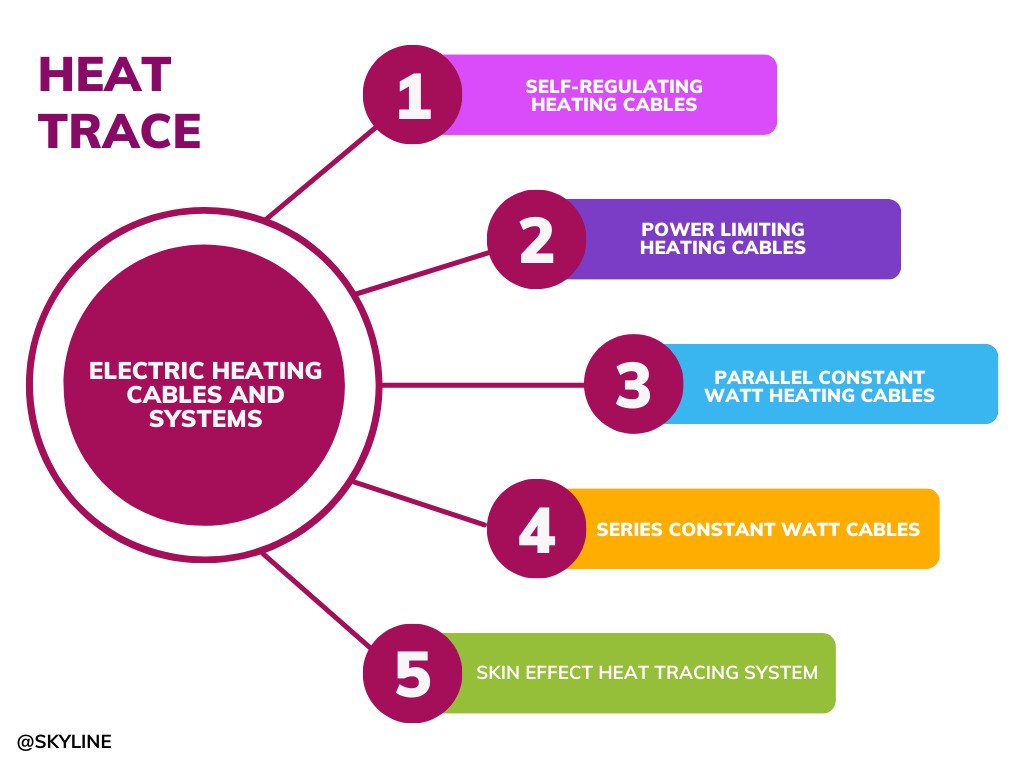
Types of Electric Heat Trace Cables
1. Self-Regulating Heating Cables
- Operation: These cables adapt their heat output to the ambient temperature. When the temperature rises, the resistance of the cable increases, which reduces the heat dissipation, and vice versa.
- Applications: Frost protection for pipes, tank heating, de-icing of roofs and gutters.
2. Power Limiting Heating Cables
- Operation: These cables deliver a constant heat output up to a certain temperature and then limit the power output to prevent overheating.
- Applications: Maintaining process temperature in industrial environments,heating pipelines.
3. Parallel Constant Watt Heating Cables
- Operation: These cables deliver a constant heat output per unit length, regardless of the ambient temperature. They are usually cut to length and are easy to install
- .Applications: Frost protection, for pipes, underfloor heating, de-icing of roofs and gutters.
4. Series Constant Watt Heating Cables
- Operation: These cables also offer constant heat dissipation but are designed for fixed length installations. They are extremely durable and suitable for harsh environments.
- Applications: Heating of large areas, heating of pipelines, heating of industrial processes.
Benefits of Electric Heat Trace
- Prevents pipes from freezing : Protects pipes from freezing and bursting in cold weather.
- Maintains process temperatures: Ensures that liquids and gases in pipes remain at the temperature required for industrial processes
- Increases safety: Reduces the risk of accidents or damage caused by freezing or temperature fluctuations.
- Energy efficient: Self-regulating cables adapt their heating output to the ambient temperature, saving energy.
Comparison Table of Applications
| Cable Type | Primary Applications | Advantages | Disadvantages |
| Self-Regulating Heating Cables | Pipe freeze protection, tank heating, de-icing systems | Adjusts heat output, prevents overheating, energy-efficient | Higher cost, degrades over time |
| Power Limiting Heating Cables | Industrial process temperature maintenance, pipeline heating | Precise and constant heat, durable | Requires additional control systems, higher installation cost |
| Parallel Constant Watt Heating Cables | Pipe freeze protection, floor heating, de-icing systems | Constant heat output, customizable length, easy installation | Higher energy usage, requires control systems |
| Series Constant Watt Heating Cables | Industrial process heating, large area heating, pipeline heating | Constant heat output, durable, suitable for large areas | Fixed length, complex installation, entire cable fails if damaged |
Summary
Electric heat tracing systems are essential for maintaining and regulating temperatures in various applications, especially in cold climates and industrial processes. They provide a reliable and efficient solution to prevent freezing and ensure the proper functioning of systems that require special temperature maintenance.