
Understanding Operating Temperature and Maintain Temperature in Electric Heat Tracing Systems
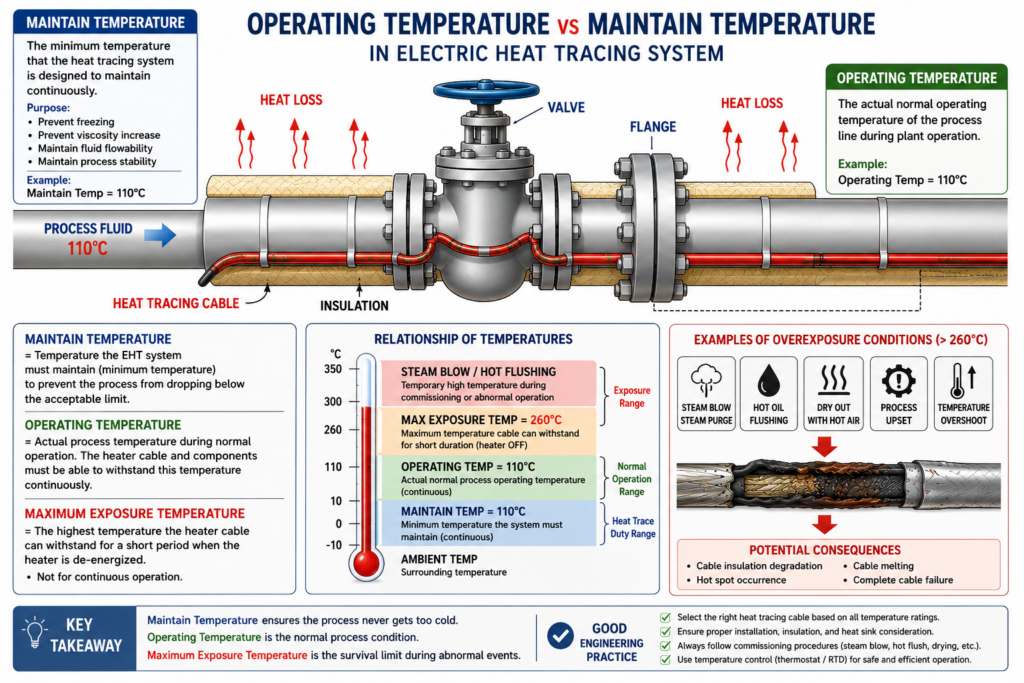
Introduction
In Electric Heat Tracing (EHT) systems, two terms frequently appear in design documents, datasheets, and engineering calculations:
- Operating Temperature
- Maintain Temperature
Although these terms sometimes show the same numerical value, their meanings are different and extremely important for proper heater cable selection, safe operation, and reliable system performance.
Misunderstanding these temperatures can lead to:
- Incorrect heater selection
- Cable overheating
- Insufficient heat maintenance
- Premature cable failure
- Unsafe operating conditions
This article explains the difference between these terms in a practical engineering context.
1. What is Maintain Temperature?
Definition
Maintain Temperature is:
The minimum process temperature that the Electric Heat Tracing system is designed to maintain continuously.
In simple terms:
Maintain Temperature
= Temperature the process must NOT fall below
The purpose is usually to:
- Prevent freezing
- Prevent viscosity increase
- Prevent crystallization
- Maintain fluid flowability
- Maintain process stability
Example
A chemical process line requires the product to stay at:
110°CIf the temperature drops below this point:
- The product becomes too viscous
- Flow becomes difficult
- Process quality is affected
Therefore:
Maintain Temperature = 110°CThe heat tracing system must continuously compensate for heat loss to keep the line at this temperature.
2. What is Operating Temperature?
Definition
Operating Temperature is:
The actual normal operating temperature of the process line during plant operation.
In practical engineering:
Operating Temperature
= Real process temperature during operation
This value is usually provided by:
- Process Engineer
- Client
- Process datasheet
- P&ID specification
- Line list
Example
A hot oil line normally operates at:
180°CTherefore:
Operating Temperature = 180°CThis temperature represents the actual temperature the pipe and heater cable will experience during normal plant operation.
3. Key Difference Between the Two
| Parameter | Maintain Temperature | Operating Temperature |
|---|---|---|
| Purpose | Minimum temperature to maintain | Actual process operating temperature |
| Used For | Heat loss calculation | Cable selection and temperature verification |
| Defined By | EHT Design Requirement | Process Design |
| Focus | Prevent cooling | Normal operating condition |
| Related To | Heat tracing performance | Process operation |
4. Why They Are Sometimes Equal
In many projects:
Maintain Temp = Operating TempExample:
| Parameter | Value |
|---|---|
| Operating Temp | 110°C |
| Maintain Temp | 110°C |
This means:
- The process normally operates at 110°C
- The EHT system must maintain 110°C continuously
This is common in:
- Chemical process lines
- Polymer systems
- Fuel oil systems
- Viscous fluid applications
5. Why They Can Be Different
In some systems:
Operating Temp ≠ Maintain TempExample 1 — Hot Oil Line
| Parameter | Value |
|---|---|
| Operating Temp | 180°C |
| Maintain Temp | 80°C |
Explanation:
- Process normally runs at 180°C
- During shutdown, only 80°C is needed to prevent solidification
The EHT system is designed only for 80°C maintenance.
Example 2 — Wax Line
| Parameter | Value |
|---|---|
| Operating Temp | 140°C |
| Maintain Temp | 60°C |
Explanation:
- Product flows at 140°C during operation
- Heat tracing only prevents wax solidification during idle periods
6. Relationship with Heater Cable Selection
These temperatures directly affect heater cable selection.
The engineer must verify:
1. Cable Maintain Capability
Can the cable maintain the required temperature?
Example:
Required Maintain Temp = 110°CThe selected heater cable must support at least this temperature.
2. Cable Operating Capability
Can the cable continuously survive the operating temperature?
Example:
Operating Temp = 110°CThe cable insulation and heater material must tolerate continuous exposure at this temperature.
7. The Most Important Temperature:
Maximum Exposure Temperature
This is often the most critical parameter.
Definition
Maximum Exposure Temperature is:
The highest temperature the heater cable can tolerate without damage, usually when the heater is de-energized.
Example:
| Parameter | Value |
|---|---|
| Maintain Temp | 110°C |
| Operating Temp | 110°C |
| Max Exposure Temp | 260°C |
This means:
- Cable can continuously operate at 110°C
- Cable can survive temporary exposure up to 260°C
8. Why Maximum Exposure Temperature Matters
During commissioning or abnormal operation, the process line may experience:
- Steam blow
- Steam purge
- Hot oil flushing
- Dry-out operation
- Process upset
- Temperature overshoot
These conditions may temporarily raise pipe temperatures above normal operating conditions.
If the cable exposure exceeds its limit:
Cable jacket degradation
→ Insulation damage
→ Thermal runaway
→ Cable melting
9. Real Field Failure Example
A Constant Wattage (CWM) cable had:
| Parameter | Value |
|---|---|
| Maintain Temp | 110°C |
| Operating Temp | 110°C |
| Max Exposure Temp | 260°C |
During plant commissioning:
- Steam purge occurred
- Pipe temperature exceeded 300°C
- Heater remained energized
Result:
Severe cable melting and insulation failureEven though the design operating temperature was only 110°C.
10. Common Engineering Mistakes
Mistake 1
Assuming Operating Temp equals Heater Surface Temp.
Not always true.
Local hot spots at valves and flanges can be much hotter.
Mistake 2
Ignoring Maximum Exposure Temperature.
This is one of the most common causes of cable failure during commissioning.
Mistake 3
Using Maintain Temp only for cable selection.
The engineer must verify:
- Maintain capability
- Operating capability
- Exposure capability
All three are critical.
11. Engineering Best Practice
Before selecting a heater cable:
Verify:
- Maintain Temperature
- Operating Temperature
- Maximum Exposure Temperature
- Ambient Temperature
- Insulation Thickness
- Valve and Flange Adders
- Hazardous Area Classification
12. Conclusion
In Electric Heat Tracing systems:
Maintain Temperature
Defines:
The temperature the EHT system must maintainOperating Temperature
Defines:
The actual process operating temperatureThese values may be identical or different depending on process requirements.
However, the most critical parameter for cable survival is often:
Maximum Exposure TemperatureUnderstanding the relationship between these temperatures is essential for:
- Proper cable selection
- Reliable operation
- Safe commissioning
- Long heater life
- Preventing thermal failure
A properly designed EHT system must consider all three temperatures together, not individually.