
How to Megger Test Heat Trace Cable
Proper Insulation Resistance Testing for Electric Heat Tracing Systems
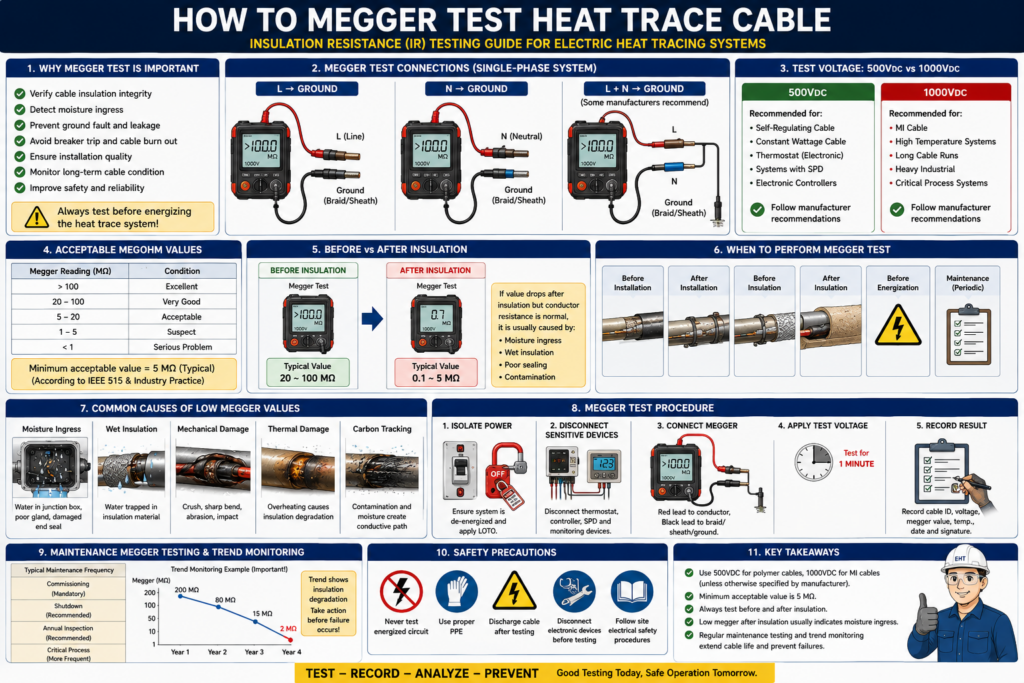
Introduction
Megger testing, also known as:
Insulation Resistance (IR) Testingis one of the most important tests in Electric Heat Tracing (EHT) systems.
This test is used to verify:
- Cable insulation integrity
- Moisture ingress
- Mechanical damage
- Ground faults
- Installation quality
- Long-term cable condition
A proper Megger test can detect hidden problems before energizing the system and helps prevent:
- Ground faults
- Breaker trips
- Heater cable burnout
- Electrical leakage
- Fire risk
In industrial projects, Megger testing is typically performed:
- Before installation
- After installation
- Before insulation
- After insulation
- Before energization
- During maintenance shutdown
This article explains proper Megger testing practices according to industrial standards such as IEEE 515 and common manufacturer recommendations.
1. What is a Megger Test?
A Megger test measures:
Insulation Resistance (IR)between:
- Conductors and ground
- Conductors and metallic sheath
- Line and neutral
The Megger applies a DC voltage and measures leakage current through insulation.
Higher resistance means:
Better insulation conditionLower resistance indicates:
- Moisture
- Insulation damage
- Carbon tracking
- Contamination
- Ground fault
2. Why Megger Testing is Critical in Heat Tracing
Heat trace cables operate in harsh industrial environments:
- High temperature
- Moisture
- Thermal cycling
- Outdoor exposure
- Mechanical stress
- Chemical exposure
Without Megger testing, hidden insulation problems may go unnoticed until:
- Breaker trips
- Cable burns
- Heater fails
- Ground leakage occurs
Megger testing is especially important for:
- MI Cable
- Self-Regulating Cable
- Constant Wattage Cable
- Hazardous Area installations
3. Typical Megger Test Connections
For Single-Phase Heat Trace
Measure:
L → Ground
Line conductor to braid/sheath/groundN → Ground
Neutral conductor to braid/sheath/groundL + N → Ground
Some manufacturers recommend tying conductors together.
4. 500VDC vs 1000VDC
One of the most common questions is:
Should Megger testing use 500VDC or 1000VDC?5. IEEE 515 Guidance
IEEE 515 generally recommends:
| System Type | Typical Test Voltage |
|---|---|
| Polymer Heat Trace | 500VDC |
| MI Cable | 500VDC or 1000VDC |
However:
Always follow manufacturer recommendations first.because some electronic components or thermostats may be sensitive to higher test voltages.
6. Typical Manufacturer Practices
Self-Regulating and Constant Wattage
Usually tested with:
500VDCbecause polymer insulation may degrade if excessive voltage is repeatedly applied.
MI Cable
Typically tested with:
1000VDCbecause MI cable insulation is highly robust.
7. When to Use 500VDC
Recommended for:
- Self-Regulating cables
- Constant Wattage cables
- Electronic thermostat systems
- Systems with surge protection devices
- Sensitive electronic controllers
8. When to Use 1000VDC
Recommended for:
- MI Cable
- High-temperature systems
- Long cable runs
- Heavy industrial installations
- Critical process systems
9. Acceptable Megohm Values
Typical Industry Values
| Megger Reading | Condition |
|---|---|
| > 100 MΩ | Excellent |
| 20–100 MΩ | Very good |
| 5–20 MΩ | Acceptable |
| 1–5 MΩ | Suspect |
| < 1 MΩ | Serious problem |
10. IEEE 515 and Common Acceptance Criteria
In many industrial projects:
Minimum acceptable value
= 5 MΩ
especially:
- After installation
- After insulation
- During maintenance
11. Why Values Drop After Insulation
A common field situation:
Before insulation
20 MΩAfter insulation
0.7 MΩbut conductor resistance remains normal.
This usually indicates:
Moisture ingressrather than conductor failure.
12. Common Causes of Low Megger Values
Moisture ingress
Most common cause.
Water may enter through:
- Junction boxes
- Glands
- End seals
- Damaged outer jackets
Wet insulation
Water trapped in thermal insulation reduces insulation resistance.
Mechanical damage
Examples:
- Crushed cable
- Sharp bend
- Abrasion
- Impact damage
Thermal damage
Overheating may carbonize insulation.
Carbon tracking
Contamination and moisture may create conductive paths.
13. Megger Test Before Insulation
This is one of the most important tests.
Purpose:
Verify cable integrity before insulation covers the system.Why This Test Matters
Once insulation is installed:
- Visual inspection becomes difficult
- Repair cost increases dramatically
Recommended Checks
Before insulation:
- Megger test
- Conductor resistance test
- Visual inspection
- Connection verification
14. Megger Test After Insulation
This test verifies:
- Insulation work quality
- Weather sealing
- Moisture protection
- Mechanical damage during insulation work
Common Problems Found After Insulation
- Water ingress
- Cable damage by insulation crew
- Missing weatherproof seal
- Compression damage
- Wet insulation material
15. Maintenance Megger Testing
Periodic maintenance testing is essential.
Typical schedule:
| Frequency | Typical Practice |
|---|---|
| Commissioning | Mandatory |
| Shutdown | Recommended |
| Annual inspection | Recommended |
| Critical process | More frequent |
Trend Monitoring
The most important factor is:
Megger trend over timeExample:
| Year | Megger Reading |
|---|---|
| Year 1 | 200 MΩ |
| Year 2 | 80 MΩ |
| Year 3 | 15 MΩ |
| Year 4 | 2 MΩ |
This trend indicates progressive degradation.
16. Megger Testing Procedure
Step 1 — Isolate Power
Ensure:
System completely de-energizedApply LOTO if required.
Step 2 — Disconnect Sensitive Devices
Disconnect:
- Electronic thermostats
- Controllers
- Surge protectors
- Monitoring systems
to avoid damage.
Step 3 — Connect Megger
Example:
Positive lead
To conductorNegative lead
To braid/sheath/groundStep 4 — Apply Test Voltage
Typical duration:
1 minuteStep 5 — Record Value
Document:
- Cable ID
- Voltage used
- Megger value
- Ambient temperature
- Date
- Technician name
17. Safety Precautions
Megger testing uses high DC voltage.
Important precautions:
- Never test energized circuits
- Discharge cable after testing
- Disconnect electronics first
- Use proper PPE
- Follow site electrical safety procedures
18. Common Mistakes During Megger Testing
Testing through electronics
May damage controllers or thermostats.
Not disconnecting surge protectors
Can cause false low readings.
Wet cable surface
May produce misleading results.
Not recording trends
Single readings are less useful than trend history.
19. Real Industrial Example
Symptoms
- Breaker trip during startup
- Heater not warming properly
Test Results
Before insulation:
35 MΩAfter insulation:
0.8 MΩInvestigation
Insulation removal revealed:
- Wet insulation
- Damaged weather seal
- Water ingress at junction box
Root Cause
Moisture ingress after insulation installation20. Conclusion
Megger testing is one of the most critical quality control and maintenance procedures in Electric Heat Tracing systems.
It helps detect:
- Moisture ingress
- Insulation degradation
- Mechanical damage
- Ground faults
- Thermal damage
before catastrophic failure occurs.
Proper testing should follow:
- IEEE 515 guidelines
- Manufacturer recommendations
- Site electrical safety procedures
The most important practices include:
- Testing before insulation
- Testing after insulation
- Periodic maintenance testing
- Monitoring long-term IR trends
A properly maintained Megger testing program significantly improves:
- Heater reliability
- System safety
- Operational stability
- Cable lifetime
- Plant uptime